Showing posts with label Research. Show all posts

Friday, 16 March 2018

Landscape, Natural Beauty and the Arts; Edited by Salim Kemal and Ivan Gaskell

In my Tutor report for Assignment 4 Robert Bloomfield mentioned that he felt that I had improved my blog but he was unsure about the heading image (at that time a shot from the Lake District complete with rainbow).  "I do wonder about the pastoral image for the header image though.  It screams landscape painting at me, eg Constable and his middle distances, whereas your work is so photographic."  He suggested that I might Landscape, Natural Beauty and the Arts especially Chapter 2 Natural Beauty Without Metaphysics.

Natural Beauty Without Metaphysics; T.J.Diffey

I found this essay readable and enjoyable with much food for thought.  I list below the points that I felt to be of most relevance to my work:
  • Plato and the eighteenth-century British, and especially Scottish, philosophers were interested in the topic of beauty.
  • ......whether beauty is a real quality, or whether judgments of beauty are subjective or objective....
  • ....extreme subjectivism and relativism must hold sway.
  • ...aesthetic subjectivisim......that the beautiful is to be defined as what pleases me. (INteresting that the auther feels there is no objective definition of beauty)
  • ....and relativism as what pleases some social group.
  • My tastes may be my tastes but they......must be the product of my environment, genes, gender, class, society, education, occupational group or whatever.
  • ...disputes rage over matter of taste.....
  • For there is held to be no way of getting outside the circle of taste to judge what taste is better. (Who is to judge what is more/most beautiful.)
  • First, the popular idea that beauty lies in the eye of the beholder is itself intended as a philosophical answer to the philosophical question "what is beauty," and as such is not immune from criticism.
  • If everyone believes that what is beautiful is what pleases him or her, what possible grounds could there be for denying that if it pleases then it is beautiful. (But how beautiful)
  • And yet, for all the implausibility of the suggestion that natural beauty is judged and that some such judgements carry more weight than others, there is a growing institutionalization of natural appreciation, which means that in the question of natural beauty there is now some kind of authority exercised.  For example in Britain we now have officially designated "areas of outstanding natural beauty," and there is now the growing panoply of information offices, tourist trails and the like.......
  • It does not follow....that corners of nature not officially noticed cannot be beautiful.
  • There is a widespread public agreement concerning the beauty of certain landscapes.
  • ....the beauty of some particular place or thing does not seem to depend for its existence upon our having to speak of it.
  • Dunster Castle or Castle Comb do not depend for their beauty upon our speaking or thinking of them, though they do depend upon this for their popularity.
  • Yet this is not inconsistent with Kant's powerful point that we appreciate the beautiful in virtue of our rationality.  It follows that is animals are not rational in Kant's sense they are incapable of appreciating beauty.
  • Are we justified in restricting the appreciation of beauty to human beings?
  • Something happened in the history of aesthetics between Burke and Kant.  Beauty got desexualised....
  • .....natural beauty is disinterested appreciation by a rational mind.
  • ...we can all think readily enough of examples of natural beauty....
  • ....undoubtably beautiful.  This is literally true; ......
  • How "natural" does this so-called beauty have to be... ....... it is false to take "natural" as meaning the absence or exclusion of human agency...........it is very difficult (in Britain) today to find "unspoiled" tracts of nature.  (Taken to these lengths then there must be no beauty left in Britain!!)
  •  ....Even within living memory their (The Downs) look has been much altered by changes in agricultural use and methods and much improved (?) by the addition of such human artefacts as windmills. (Reference Pete Davis whose In Wildwood makes this exact point.  Also, in my extended essay for Contexual studies I argued the point that although a case can be made for the existence of relict wilderness of a sort in Lincolnshire I strongly suggested that with climate change today there is nowhere on planet Earth that remains 'untramelled by man' and, therefore, on wilderness left on the planet in the strictest sense of the word.)
  • For a scene to be naturally beautiful is not so much for it to be in an unmanaged state as for it to look as if it were. (And hence we have landscape photography such as that of Ansel Adams and Joe Cornish.  An aquaintance of mine likes landscape photographs to show the world as he would like it to look not as it really is!!)
  • To insist that nature has to be "unspoiled" to be regarded as beautiful suggests a sentimental a priori thought at work to the effect that nature must be beautiful and cannot be ugly...........but there is much in nature that, in spite of a sentimental temptation to deny it, is not beautiful.
  • So the old adage that God made the countryside and man the town lives on in another guise.
  • Nowadays we are less likely to think that some unspoiled stretch of land is a "horrid and awful waste" (such as our forebears thought the Scottish Highlands) and more likely to doubt if it can remain beautiful after the proposed intrusion of (further) human agency.  Does the the building of an atomic power station or the siting of electric pylons or an oil rig make this once-beautiful landscape now ugly? (See also Robert Mcfarlane's Mountains of the Mind where he refers to man's attitude to mountainous regions such as the Alps two or three hundred years ago.  Mountains were wastes to be feared not admired for their beauty.  Also the rash of wind farms on hills and mountains and in my case off the Lincolnshire coast.  Does that make the coast ugly where once it was beautiful, but there again many people might regard salt marsh and mudflats as ugly.  Beauty is in the eye of the beholder!!)
  • The belief that the South Downs, say, are beautiful is something which everybody shares.  Then any proposed change is regarded as a threat to its established beauty.  Natural beauty seems to consist in a general impression, which is no doubt true of a beautiful work of art too (certainly any change to a work of art will be regarded as a threat to its beauty).
  • There is a less bland way of taking these instances of accepted natural beauty, however, which is to say that there is a kind of stock natural scenery which turns up time and again in calendars and greeting cards. (Fay Godwin made the comment that she dislikes the postcard/greeting card view.  In Jesse Alexander's Perspectives on Place he makes the point that Godwin was wary of the picturesque to be found on cards i.e. the technically sound and aesthetically pleasing that many aspire to take.)
  • There are those places by shore, by river and in hills which we find immediately beautiful, but much that is obviously beautiful to us was for our ancestors a case of "difficult beauty".  The point is often made that it took the poets and painters to make available to us all the aesthetic quality of "horrid wastes" such as mountains. (See my points re Mountains of the Mind above.)
  • ....a parallel question arises: namely, whether the distinction between 'natural' beauty and 'artistic' beauty is tenable.
  • The moral is that we cannot understand the idea of natural beauty with considering certain concepts more restricted in scope such as landscape, view or prospect.
  • To identify something more determately than a 'nature', as for example a 'view', 'prospect', 'landscape' or whatever is to conceptualize it in such a way as to imply that the terrain in question has already been recognised aesthetically.  To ask if a prospect is beautiful is as odd as asking whether murder or lying are wrong.
  • And yet other aesthetic subject-terms, such as 'wilderness' may the subject of political controversy. 
  • It is no longer so commonly represented that I like the heathland as I like ice-cream, but that its preservation may have something to do with the survival of the planet Earth and plenty of people may have an interest in that. (The survival not of planet Earthbut the human species is a hobby horse of mine.  Mankind seems hellbent on destroying his/her environment through climate change, pollution (especially plastics THE pollution of the moment), war industry, oil exploration, especially in the Arctic.  However, man needs his environment and planet Earth much more than they need him.  Man maybe the first species to orchestrate its own destruction, but even if he wiped himself out with a nuclear holocaust the planet would survive.  Enough life forms would survive to repopulate the Earth and evolution could begin again.)
  • If the popular belief that beauty is in the eye of the beholder is taken reductively to mean that beauty is nothing but personal fancy, this is inconsistent with other popular beliefs such as that natural beauty is a source of spiritual sustenance.
  • The philosophical issue here is what does it mean to think of natural beauty as a source of spiritual sustenance.  This is a more important question than any in the traditional metaphysics of beauty but it goes undiscussed because of the hostility it provokes in intellectuals.
  • More surprisingly, at least one Christian has denounced the spiritualisation of nature on the grounds that it makes an idolatory of the earth for heaven, not earth is divine. (This despite the fact that 'God created heaven and earth'! As a Christian I find this surprising and blinkered!)
  • ....modern philosophy, impressed by a materialist interpretation of the science of nature, is hostile to religion.
  • In a secular society it is not surprising that there will be hostility towards any religious veneration of natural beauty and at the same time nature will become a refuge for displaced religious emotions.
  • But has beauty disappeared?...........Beauty, of course, has not disappeared, not the word nor the idea nor the phenomenon.  On the contrary the love of beauty is ubiquitous: in mass tourism, kitsch, the growing concern for the environment and sexual beauty.
  • To say that beauty has disappeared for intellectuals is to mean that it is not taken as having any intellectual relevance, that it does not figure in our understanding of anything.
  • In this respect popular opinion agrees with the intellectuals.  Beauty explains nothing.  It is only a matter of appearances; it lies in the eye of the beholder.
  • If it is the fate of beauty to have been reduced to the status merely of what is personally pleasing, the fate of art has been more complex.  For one thing art has been freed from service to the ideal of beauty..............one is the determined campain mounted in aesthetics in the nineteenth century to drive out beauty as the criterion of art.
  • Thus beauty seems to be a contestable ideal for art whereas there is nothing controversial in finding a particular landscape beautiful.
  • In a secular society art, like natural beauty, remains a last refuge for religious and noumenal truth and it retains something of this power even for the secularly and aesthetically minded and not merely for those who remain religiously inclined. (Noumenon in Kantian philosophy a thing as it is in itself, as distinct from a thing as it is knowable by the senses through phenomenal attributes.)
  • Can nature give intimation of the transcendent?  Is this what makes spiritual communion with nature, which many have felt possible, the sense that in nature and through the senses paradoxically one is in the presence of something supersensible? (I think this is so.)
  • Of course something grander than the beautiful, namely the wild and the sublime, seem to have provoked this sense of the transcendent in nature. (Muir, Thoreau, Emerson.)
  • The modern world, I suggest, does not permit us a Wordsworthian faith in the divinity of nature. (?)
  • ....in these references to Wordsworth, we seem to have slipped from the subject of natural beauty into that of the sublime without noticing the difference.
  • ....so far as nature goes we do not nowadays pay much attention to any significant distinction between the beautiful and the sublime.  The sublime in nature is a species of the beautiful, the beauty of wild and grand places, but is no further significant.
  • ......it seems clear that art, by contrast with nature, can manage without beauty, at least the beauty of the more obvious sorts.
  • I am more willing to consider what the expression, a truthful work of art, might mean, than what a truthful landscape or prospect might mean or be.
  • Art speaks, or is like a language, whereas beauty and, therefore natural beauty is dumb. (I can see where he is coming from here.)  Historically the idea that nature is a language or book that we can read has been particularly powerful in the development of western science but to my mind is now no more than an archaic and merely beautiful figure. (?)
  • I have been critical of certain traditional answers but have offered no contemporary solution.  Is this because the idea of natural beauty is untenable and so as philosophical interest in beauty weakened it mad no provision for the idea of natural beauty or is it that we have been blind to the problem?  I prefer to believe the latter.
I found this essay interesting and thought provoking.  It touched on several areas of particular interest to me, but I am sure that it has helped with my choice of website header image, however, I have changed it to one more fitting for my final body of work.

Monday, 12 March 2018

Pete Davis, In Wildwood.

Pete Davis

For 18 years Dr Pete Davis was a senior lecturer in Documentary Photography at the University of Wales, Newport, South Wales and for 9 of those years he was course leader.  He is currently visiting lecturer at several universities as well as being involved with his own projects and collaborations.  He is widely internationally exhibited and in 2017 had a retrospective exhibition at the National Library of Wales.  I came across Pete Davis while carrying out some other research and was amazed when I saw that he had completed a body of work entitled In Wildwood.  Intrigued I managed to locate some of these images and was amazed at how similar his work was to that to my series Impenetrable Woodland as part of my Bewildered project.  Researching further I managed to get hold of a second hand copy of the book.

In Wildwood.

I was particularly taken with Davis' quote from Robert Frost's 1920 poem 'The Road Not Taken':-
I shall be telling this with a sigh
Somewhere ages and ages hence:
Two roads diverged in a wood, and I -
I took the one less travelled by, and that has made all the difference.

Not only do I feel that this epitomises my work in Shul, but is a good description of my photography.  I could have remained in my comfortable rut enjoying my traditional wildlife and landscape photography, but I signed on to study for my OCA degree.  At times earlier on during Level 3 I was tempted to stop as I felt I was struggling.  However encouragement from peers and tutors helped me to continue and take 'the road less travelled'.  (OK enough of the sentimental stuff!!)  In his introduction Pete Davis tells us that he has always been fascinated by woodland and through this project he has attempted to encapsulate many of his ideas by concentrating on this one topic.  He discusses the importance of forests to man and his long association with them and goes on to suggest that the term 'wildwood' can evoke images of remoteness and danger as well as sinister beauty.  He moves on to say, though, that the wildwoods of his project owe their presence and visual appearance to centuries of management and human intervention.  In the work he says that he has tried to encapsulate many of the elements of the wider landscape that have featured in his work over the years: beauty, mystery, myth, spirituality and history.

In an essay that accompanies the book Conway Lloyd Morgan discusses the occurrence of forests in literature such as Tolkein's Lord of the Rings, but goes on to say that forests were part of a shared landscape : respected, not owned, but not hostile or alien either.  He tells us that Pete Davis is a Welsh photographer for whom such managed forests have become a major subject in recent years.  He explains that photographing a forest is not an easy thing to, especially with the large-format (10x8) field camera that Davis uses along with its associated tripod, plates and lenses.  Not only is the weight considerable but he could only take 10 images in a session so each one had to count.  It was also a problem of when to photograph; if he had done recces with a smaller camera conditions would have been different when he returned with the large-format gear so the opportunity had to be taken when it arose.  We are told that the images do not document the history or archaeology of forests, nor animal activity or seasonal changes; instead they invite the viewer  to construct an indepentent narrative for the space in much the same way that I hope my images in Shul do.

I found the images in this book entrancing; I can look at them time and again.  I like to think that my work evokes the same response.  I would have loved to have seen these photographs at 2x3m on a gallery wall.


Monday, 19 February 2018

John Muir: My First Summer in the Sierra

I have long known about John Muir:  born in Scotland where there is a John Muir Trail along the Forth coastline, the father of American Conservation and founder of The Sierra Club.  What I didn't realise was his prowess as a climber, although he is very matter of fact about this.  I was fascinated to read in this book of some of the rock climbs he pioneered in the Yosemite area with virtually no equipment other than boots; some of these climbs are considered more than respectable even today.

I loved this book.  It describes his first foray into the High Sierra and what is now Yosemite National Park.  He was employed by a sheep rancher to to help drive his sheep from the hot and arid summer lowlands of the coastal plain up into the lush grasslands of the Sierra for the summer and eventually back down to the home ranch when the first storms of Autumn arrived.  He describes his first visit to Yosemite Valley in 1869.  Although, many years ago, I naively thought that Yosemite was pure and untouched wilderness (too much Ansel Adams!!!) I quickly realised that that is not the case - even Adams complained in a 1930s letter to his fiancee in San Francisco of the traffic jams in the valley.  Even so I was fascinated to discover that even in 1869 there was at least one hotel in the valley and tourists were already being catered for.  Despite all of my 21st century knowledge of American wilderness I very much enjoyed reading what it was like in the mid 19th century.

I was very pleased to read Robert MacFarlane's 2007 introduction to the book, however, as this very much puts it into context.  MacFarlane says of him that he grew to resemble the land he loved so much; he described himself as 'poetico-trampo-geologist-bot. and ornith-natural. etc!!!'. There are says MacFarlane, so many Muirs:  long-distance tramp,  mountaineer, geologist, explorer, botanist, activist and the nature writer who communicates the joy of being out of doors.  He says of him that he is often thought of as third in a list which includes Thoreau and Emmerson at its top but it is his ablity to communicate that makes him at least as important as either of his predecessors.  In North America, MacFarlane relates, Muir is thought of as a prophet and as 'Father of the National Parks'.

In 1875 Muir wrote, "wilderness is a necessity; and mountain parks and reservations are useful not only as fountains of timber and irrigating rivers, but as fountains of life."  The fact that landscape might be valued not in terms of economic or agrarian resources, but in terms of its profound spiritual effect is the legacy that he bequeathed to us today.  Robert MacFarlane also quotes from American novelist and essayist Wallace Stegner who said "we simply need....wild country available to us, even if we never do more than drive to its edge and look in.  For it can be a means of reassuring ourselves of our sanity as creatures, a part of the geography of hope."  This reminds me of green therapy as written about by Richard Mabey in Nature Cure.

John Muir had an incredibly hard and bleak upbringing in Scotland by his Calvanist father and this continued after their move to America to be farmers.  However, in the course of that one summer in 1869, he describes his spiritual conversion from the son of a preacher-man to a child of nature.  When, in 1868, on arrival in San Francisco he inquired as to the whereabouts of the nearest wild place; he was directed to Yosemite and so signed on as a shepherd to lead sheep up into the high country and Yosemite.  He writes lyrically of his experiences.

Although admiring Muir, Robert McFarlane points out that he is not without his faults.  First of all he points out that he suffers from the kind of misanthropy that gets environmentalists a bad name.  He loathes the tourist and we hear the voice of the human-hating wild walker, the elitist ecologist: only those who look properly, only those who can apprehend nature's magic, should be allowed into these places.  More worryingly MacFarlane points out his attitude to the  Native Americans who were driven out of their lands in Yosemite.  He refers to them as dirty, superstitious, deadly, quarrelsome and wife-stealing.  He points out that the Yosemite that Muir experienced seemed in part so wild because its previous inhabitants had been evicted from it.  Yosemite was not empty but emptied out.  MacFarlane argues that Muir did not see this clearly enough.  He did subsequently, however, come to know them better and much later in life he would spend time living among various tribes.  He eventually became a significant advocate of Native American rights an history.

After that first summer, Muir hardly left the vally at all for six years.  In fact he became an early psychogeographer.  He said, "I must drift about these love-monument mountains, glad to be a servant of servants in so holy a wilderness."  So, says MacFarlane, drift he did; embarking on the derivé: climbing and exploring, walking thousands of miles, discovering living glaciers, mapping the distribution of giant redwoods, and building up the formidable archive of natural experience which would issue into his prose.

Later in life he turned political and began to lobby for the preservation of the landscapes he loved.  He founded the Sierra Club and was instrumental in the establishment of National Parks.  One main achievement was to explain the sense of the spiritual worth of wildness.  He asked not what wild places can do for us but what they can do to us.

Robert MacFarlane concludes his introduction by arguing that the cost of losing our wild places would be devastating and he quotes Auden who stated that 'A culture is no better than its woods.'

Sadly we are rapidly heading to a state where humans may become the first species to orchestrate its own extinction.  The planet would recover although our species would not.  We need the planet far more than it needs us.

Friday, 29 December 2017

Similarity of my BOW to Klimt Landscapes

When international artist and curator, Linda Ingham, gave me feedback on my body of work as part of SYP assignment 1, she mentioned that my work reminded my of Klimt landscapes.  Although familiar with Klimt's work (I have a silk tie with The Kiss on it) I was unaware that he had painted landscapes.  Having googled the subject I came up with a whole range of his work such as the ones shown below.


These immediately reminded me of the following photograph, the final one in my series.
I also have others in a similar vein taken more recently as part of the development of my project.


The second of the Klimt paintings is called Forest/1901 and is on display in The Tate.  The Tate website tells us that while his landscape work dates from the 1880s, it was not until the late1890s  that he turned consistently to landscape painting whilst on holiday near the city of Salzburg. After the early 1900s when he had given up large public commissions and he relied on selling his work, the website tells us that these landscapes proved useful.

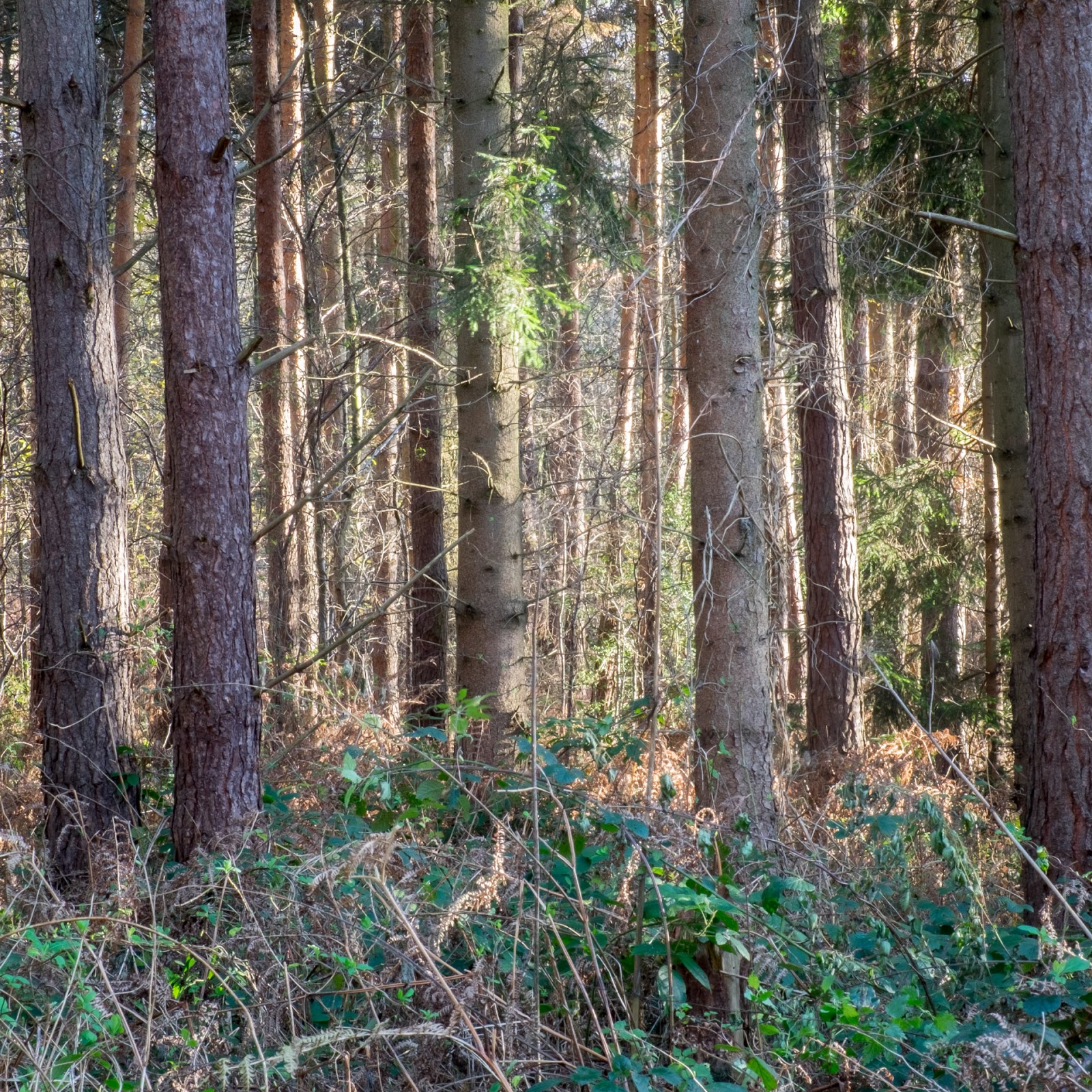
His landscapes are now highly sought after and I was interested to read that a particular feature of the paintings is their standard size and square format which he used with exhibition in mind.  I was particularly taken when I read this as, as can be seen in the images above, I have chosen a square format with no horizon.  This is largely for uniformity but also to remove myself somewhat from the romantic picturesque.  I favour the lack of horizon to encourage the viewer to look more closely at the image as it is more difficult to place it as a landscape.  As Joseph Wright says of Matthew Conduit's work in the Inside the Outside website: "All peripheral information and most references to topography are discarded.  There are no skies or horizons and few focal points - in cases no 'landscape'."


Tate (2017, Gustav Klimt:Painting, Design and Modern Life in Vienna 1900:Room Guide, Gustav Klimt and Landscape [online] 
available from: http://www.tate.org.uk/whats-on/tate-liverpool/exhibition/gustav-klimt-painting-design-and-modern-life-vienna-1900/gustav-8 [accessed 29.12.17]

Wright, J (2017) Chora and Terrain Vague/Matthew Conduit  Inside the Outside Website, Available from: http://www.inside-the-outside.com/chora-terrain-vague-matthew-conduit/ [Accessed 29.12.17]

Tuesday, 19 December 2017

Bewildered

I follow Robert MacFarlane on Twitter and recently came across this tweet for his word of the day on December 11th 2017 complete with the included image..

Word of the day: "bewilder" - "To lose in pathless places, to confound for want of a plain road" (Samuel Johnson); from the verb "wilder", meaning "to lose one's way, as in a wild or unknown place" (first usage, 1613).


I was intrigued by this as it explains the point that I have been trying to make in my BOW. In quoting from my introductory text I wrote:-

......Following a woodland path is not straightforward.  The horizon is limited.  Woods muffle external sounds leaving only birdsong, the rustling of leaves or the creaking of trees in the wind.  Choices have to be made.  The path may be broad and well-defined; boundaries may be clear with wild and tangled undergrowth beyond.  Other paths are less definite, ephemeral, a trace of a path.  Perhaps there will only be a bent blade of grass or scuffed leaves that indicate that something has passed this way.  Is the decision made to remain on the wider track, safer, more secure where many have travelled before; or is it to follow the less sure route and, if so, what is to be found at its furthest extremity?  Nothing - just the wood?  Or is there a way forward by making one’s own path and forging a new route?


I think that the point that I was making that at the end of the path when the wood appears to be impenetrable then we can be 'bewildered' as in MacFarlane's tweet.  We then have to ask ourselves "Do we turn back or forge a new path"; it is easy to become bewildered.  Included below is the final image from my BOW submitted for the November assessment.

As my work develops in SYP, I have been experimenting with including more images of 'bewiderment' perhaps pairing images of paths with images of impenetrable woodland.  Example images are shown below.:-


I have also been experimenting that sense of fear and bewilderment that we can feel in thick woodland at the end of the day.  To this end I have been playing with double exposure, ICM images, hoping to evoke those feelings.


Wednesday, 15 November 2017

The Old Ways, Robert MacFarlane

I have already read Robert MacFarlane's The Old Ways but for some while have thought the it was particularly relevant to my body of work and so decided to read it again with the body of work in mind.  Nicholas Lezard tells us in The Guardian of 2 July 2013 that 15 authors made it their book of the year in 2012.  Lezard informs us that MacFarlane prefers the @the wilder and woolier environment' and his second book The Wild Places (blog link here) tried to get as close to wilderness as is possible in the UK.  MacFarlane is more interested in paths and passes rather than summits he tells us.  We are told that this is a book about walking including the paths of the sea - this I found especially interesting and pertinent coming, as I do, from a coastal environment.  Lezard continues 'It is illuminating to be told that before the Romans came, there was an extraordinary amount of sea traffic around the British Isles and Europe, which helps account for the remarkable genetic similarity of people from various coastal regions extending from Orkney to Spain. He helps us understand what it is to see the water as as criss-crossed by routes as the land, partly by describing what it feels like to sleep in an open boat where the only navigational aid is the Pole Star.' MacFarlane actually mentions in the book that it is a good idea to turn our mental map upside down and instead of thinking of the land as criss-crossed by roads, paths and tracks, invert the idea and populate the sea with paths and the land as empty.  The above then makes sense.  I find this fascinating, especially living on the edge of the major seaway of the Humber and to think of all the traders passing up and down the river reaching far inland, along the coast and across the North Sea.  I can sea links here not only with my body of work, but also with the project I completed on flotsam and jetsam for PWDP.  Opportunities are also opened up for developing my body of work and linking it to past work.
Lezard tells us that he particularly enjoyed the way that MacFarlane coined the word xenotopia to describe an uncanny landscape.  There are paths that are not paths but xenotopic places recalls the chapter on the Broomway a contingent path along tidal sands between Wakering Stairs and Foulness in Essex.  Said to be the most dangerous path in Britain, it vies for fame with that across the sands of Morecambe Bay.  This is also pertinent to my home environment with the tidal sands and mudflats of the Humber being equally etherial and dangerous.

Writing and walking are great companions says Lezard and reminds the reader of Iain Sinclair and Will Self deal with the topic of psychogeography.  He suggests that The Old Ways is a first-rate addition to the genre.


I particularly empathised with the idea of walking The Old Ways , ancient routes that go back into the historical and even prehistorical past.  Like MacFarlane I am sure these pathways carry memories and they are certainly Shuls (the title of my body of work).  I am salso taken by how in his other books as well as this, MacFarlane sleeps out on the trail and in the woods, something I have in the pipeline.  I have have spent my whole life from an early age camping but have always had the sliver of material between myself and the world, something I intend to address.  I am also taken with his penchant for experience his environment at night, something I have begun to do and also to try to record photographically.


This book also reminds me of a family favourite of ours The Dark is Rising sequence of books for older children/adults.  The Dark is Rising itself refers often to paths and trackways especially the 'Old Ways' and has been mentioned by MacFarlane on his Twitter feed.


Below are my highlighted notes from the book:-


  • The compact between writing and walking is almost as old as literature - a walk is only a step away from a story, and every path tells. P.18
  • The Sierra Club was founded in 1892, inspired by (John) Muir's convictions that the walker's bodily contact with the wild world benefited both the walker and world, and that 'going out.........was really going in'.  P.20
  • Many references to landscape and memory.  Page 22 when writing about walking Holloways with Roger Deakin.
  • Reference to Bill Brandt photographing the Pilgrim's Way in 1950.  Not especially known for his wilderness photography I have referenced him on several occasions for this aspect of his work and have a book The Land edited by and featuring him on Twentieth Century Landscape Photographs.  P.24
  • To (Edward) Thomas, paths connected real places but they also led outwards to metaphysics, backwards to history and inwards to self.  My feelings exactly but how to record this photographically is my current challenge.  P.26
  • In non-western cultures, the ideas of footfall as knowledge and walking as a mode of thinking are widespread, often operating in particular as a metaphor for recollection - history as a region one walks back into.  P.28
  • These traces - which include place names, stories, songs and relics - are sometimes called by the Apache bike' goz'aa - 'footpints', 'tracks'.  To the Thcho people of north-western Canada, walking and knowing are barely divisible activities: their term for 'knowledge' and their term for 'footprint' can be used interchangeably.  A Tibetan Buddhist text from around 600 years ago uses the word shul to mean 'a mark that remains after that which has amde it has passed by': footprints are shul, a path is shul, and such impressions draw one backwards into awareness of past events.  Reference the title of my body of work also landscape and memory.  P.28
  • Yet Richard Long - who once walked thirty-three miles a day for thirty-three days, from the Lizard in Cornwall to Dunnet Head in northern Scotland - signs off his letters with a red-ink stamp that shows the outline of two feet with eyes embedded in their soles, gazing out at the looker.  Footfall as a way of seeing the landscape; touch as sight - these are notions to which I can hold.  And me.P.29
  • The journeys told here take their bearings from the distant past, but also from the debris and phenomena of the present, for this is often a double insistence of old landscapes: that they be read in the then but felt in the now.  The waymarkers of my walks were not only dolmens, tumuli and long barrows, but also last year's ash-leaf frails (brittle in the hand), last night's fox scat (rank in the nose), this minute's bird call (sharp in the ear), the pylon's lyric crackle and the crop sprayer's hiss.  P.33
  • Chapter 5 discusses sea paths as previously mentioned.  I have written a not to myself on P.94: Link coastal pathways to BOW.  Coasts look outwards to seaways as well as inwards to ancient trackways.  Just inland from our coast is the ancient trackway of the Bluestone Heath Road now sadly a tarmacked road.
  • One of the reasons I enjoy being with Finlay is his ability to read landscapes back into being, and to hold multiple eras of history in plain sight simultaneously.................  P.147
  • Wave-surged infralittoral rock, tide-swept circalittoral rock, micro terrains of lichen and moss.  ref. my work on micro landscapes.  P155
  • My note: Landscape and Memory and us - whole page!  P.193
  • 'No hay camino, se hace camino al andar' - 'there is no road, the road is made by walking'. P.236
  • Mostly Miguel talked about trees, introducing me to individual specimens as if to old friends............. Reference The Long View.  P.247
  • Landscape is still often understood as a noun connoting fixity, scenery, an immobile painterly decorum.  I prefer to think of the word as a noun with a hidden verb: landscape scapes, it is dynamic and commotion causing, it sculpts and shapes us not only over the courses of our lives but also instant by instant, incident by incident.  P255
  • ........and as I neared the city it felt like an allegorical journey: to have crossed a pine-forested mountain range on a series of ancient paths, sleeping out on the wayside, under a vulture-filled sky, and then to be entering on foot a walled medieval city seen first from a mountain summit, levitating from the baking plains. Describing a walk from Madrid to Segovia.  P.256
  • 'What was it Kerouac said?' asked John just before we all headed to our tents. ' "Let us sleep by rivers and purify our ears." '  P.275
  • In the Living Mountain, Nan Shepherd describes the conversion in her relationship with mountains that she experienced in the course of her life. ..................Circumambulation came to replace summit-fever for Shepherd; plateau substituted for peak. 'I believe that I now understand,' she wrote in the last paragraph of the last chapter of her book, 'in some small measure why the Buddhist goes on pilgrimage to a mountain.' Reference The Long View - walking to trees rather than bagging summits.  P.279
  • The light and the path were Ravillious's signature combinations as an artist.  Research Ravillious and Nash.  P.297
  • (Edward) Thomas loved the historical synchronicities of the chalk: the ancient path lines that were echoed in form by yesterday's plough furrows.  He liked the evidence of human mark-making and tampering over milenia - tumuli, long barrows, chalk-pits, dew ponds - testifying to a landscape that was commemorative, tending to the consecrated.  P.309
  • Edward Thomas's 1916 poem 'Roads'. Read/Research Edward Thomas.  P.311
  • Helen (Thomas) thrilled to the atavism of what she called 'the ancient ways', the sense of being connected by footfall to 'history and tradition'.  Thomas taught her how to walk differently: 'with her body, not only with her legs', feeling the landscape as she moved over it.  Landscape and memory.  P.312
  • Thomas is often described as a poet of place, but the volatility of plave fascinated him more than its reliability.  P.324
  • He's a collector, too, mostly of flowers and eggs.  Reference my egg collection made when I was a young boy 50-60 years ago!! ;-( P.334
  • Song is vital to Thomas: he is involved almost from the start in the English folk-song revival led by Cecil Sharp.  P.237
  • Connection of Thomas with Robert Frost. The Road Not Taken.  P.342
  • How hard it is to erase a path. (even on the battlefield of Arras.  P.351


Lezard, N. (2013) The Old Ways; A Journey by Foot by Robert MacFarlane, The Guardian, [online] available from: https://www.theguardian.com/books/2013/jul/02/old-ways-robert-macfarlane-review [accessed 15.11.17]

Friday, 3 November 2017

Common Ground, Rob Cowen

Following his move to London to the outskirts of Harrogate Rob Cowen finds himself in unfamiliar territory.  About to become a father for the first time, disorientated, hemmed in by wimter and yearning for open space he ventures out to a nearby edge-land.  Over the following months he discovers its many layers and lives: animals, plant and human.  As the birth of his child approaches his relationship with this space where human and nature meet becomes increasingly profound.  This is a portrait of people and place through time and an exploration of the common ground we share with the natural world, the past and each other.

I found this a fascinating read and it has many connections for me: with my own interests and my work on walking and wilderness.  It inspired me to explore and photograph my own local edge land more full over the summer and early autumn.


Below are my main points from the book.


  • A feeling of being alive and in the moment. P.5
  • Perhaps because of the proliferation of those myths, mine was the last generation to lay claim to the edges in a meaningful sense.  A great societal shift indoors was already in motion.  P.5
  • Together they encircled the unmistakeable form of a holloway (ref MacFarlane).  This exuded the same mysterious gravitational pull of all ancient paths; I was drawn into its high-hedged heart, aware I must be tracing footsteps sculpted over millenia. (ref BOW, walking, Macfarlane's The old Ways)  P.7
  • For many years I had sought and written about wildness encountered in the more expected places: the rarified national park, the desolate moor, the distant mountaintop, the sweeping coast but I'd forgotten that there is something deeper about the blurry space surrounding us all where human and nature meet.............Enmeshed in every urban edge is also the continuous narrative of the subsistence of nature, pragmatic and prosaic, the millions of things that survive and even thrive in the fringes.  P9
  • There is a depth that comes from revisiting a place relentlessly.  P.9
  • Once upon a time the edges were the places we knew best.  They were our common ground.  Times were hard and spare but the margins aorund homesteads, villages and towns sustained us.  People grazed livestock and collected deadfall for fuel.  Access and usage became enshrined as rights and recognised in law.  P11
  • Humans a re creatures of habit: we still go to the edges to get perspective, to be sustained and reborn......clouds, hyper-real TV shows, 3D films, multiplayer games, online stores and social media networks - these are today's areas of common ground, the terrains where people meet, work, hunt, play, learn, fall in loce even.  P.12
  • You see, I still believe in the importance of edges.  Lying just beyond our doors and fences, the enmeshed borders where humans and nature collide are microcosms of our world at large, an extraordinary, exquisite world that is growing closer to the edge every day...........nature isn't just some remote mountain or protected park.  it is all round us.  It is in us.  It is us. (weeds growing out of the pavement down our road).  P.12
  • Most people don't even notice such things, but just look around you.  The moss-swollen pavement crack, the rosette of a dandelion defying a driveway or a gutter-growing sow thistle, these are glimpses of what lies beneath and beyond.  The deep past and the far future.  P15
  • A long, rectangular block of masonry and concrete, green with algae, was almost entirely consumed by bare vegetation.  P.19
  • The railway's closure in 1964 heralded an unglamorous downfall.  Unneeded, unnoticed, I found it shut off, shackled and destitute, left to the plumes of dead Oxford ragwort and buddleia that bristled from its cracks.P.21
  • The red fox....However, unlike many rural mammals in the UK, which have seen a sharp decline brought about by hunting, modern farming methods and the privatisation and monoculturism of land, the fox has adapted to whatever environment we have thrust upon it, sticking for the most part to its own set of territorial rules.  P29
  • This centuries old (scots pine) tree begs to differ.  With its resplendent poise and beauty, it is the very essence of wildness and craggy moor, a poster boy from the ancient Caledonian Forest.  P31
  • Perhaps, but the edge-land provides a mental and physical transendence greater than I've felt in any gallery.  P34
  • The corrals or 'parks' were therefore prime spots for the hunt, carefully maintained and policed by 'Foresters', the local workers who lived on and around the land.  These men enforced William's brutal forest law over the rest of the community.......P122
  • It's a fact that never fails to jolt my brain: the idea of private ownership of land as we know it today is only a few hundred years old.......Britain's patchwork of farms, fields and woods today is an almost entirely privatised plave, three quarters of which is owned by the wealthiest 1% of the population.  P126
  • They knew of equinoxes and solstices and rejoiced in those heady high points in the wheel of the year.  The felt a sense of belonging difficult for our removed minds to comprehend or understand............Everything changed with enclosure.  P128
  • Wealth would be made from the land...............Many thousands were dispossessed and the peasantry reduced to selling labour to a rising class of tenant farmers who, requiring far fewer men to manage sheep no longer needed their work.  P129
  • Our profound alienation from the earth continues.  We're the landless and listless, so estranged from our planet, so removed from the decision-making that governs it, so isolated from each other and the life we share this world with that we're seemingly unable even to come together and prevent global human and environmental catastrophe.  P.135
  • There is that rich smell of wood from the houses, the clean linen aroma of detergent swilling down our drains.  Our tangle with the lnd is a messy business.....  P136
  • There are voices today that call for 're-wilding', the rmoval of the human hand from the land altogether......vanished species reintroduced......trees spring up over sheep-cleared hills.....part of me craves this too; I want to believe that this could only be a good thing, but there are nagging doubts: where are we in this picture?........................ ..........................................................................  P137 Whole page relevant
  • It is a paradigm for where past realities meet our now mediated existencies.  Perhaps there's something in that.  Of course we have to live in this modern world, but we must get our boots dirty too.  We need to slip between these semi-permeable states, for just as we need our homes and X-rays, we need the intimacy of nature, the empathy and the sense it brings of our participation in a larger, living world.  Crucially we need to be in in order to connect on this physical, emotional level, down among the soil and the stems.  P.139
  • .......the sublime where you least expect it; when you most need it.  P. 195
  • That feeling of being fully in the moment and fully aware the moment won't last. (Over Owler Tor Sunrise)  P.204
  • Right now I can sense something bigger in the curvature of the horizon, the birdsong, the unearthly crawling of insects and the immeasurable flowers.  Something exquisite, enriching, frightening, indifferent, immortal.  And I realise it doesn't care whether I'm here or not.  Nature/the planet is indifferent.  ref Gaia.  Also talk by Ray Mears, 2.11.17, on caring for the environment: "Whatever we do to damage it the planet will rock on.  It is the ecosystem that we depend on that will cease to exist.  The planet has managed perfectly well without the dinosaurs"  Also a point made in my CS extended essay: "We may be the first species to orchestrate its own extinction."  P.204
  • We project all we are and all we know onto landscape.  And. if we're open to it, the landscape projects back into us.  Time spent in one place deepens this interaction, creating a melding and meshing that can feel a bit like love.  Again Ray Mears: "Being involved in bushcraft  is a way of connecting with the landscape.  P.205
  • Town-bruised, town-battered, the birth of the edge-land has been a messy one. P.223
  • ......the first hurdle was trying to understand who had responsibility for this liminal space.  P.230
  • No what happened was largely a letting-go, an end to the human interference or management, aside from the few still-worked fields (my edge-land) and the council's yearly cutting of its hay meadows. (Ref George Monbiot's vision of rewilding)  P.233
  • .......being written only three years after the clean-up, it testifies to the speed and sponteneity with which nature had reclaimed the ground. (Rewilding)  P.234
  • All I can think about is how I don't want those men hacking away.  How I don't want them interferring, cutting down things that they don't know or care about.  How I don't want any part of the edge-land, my edge-land, to be ruined.  And how I can't do anything about it. (Ref The Horsefield -my edge-land and the possible building of a new stadium for Grimsby Town on it.)  P.248
  • Thanks to my mother and father the fringe had always been a mysterious and wild adventure playground, a refuge, frontier and portal since childhood.  P250
  • It's moments like these that make you think places have a memory of their own.... ..............It's hardly a theory, more a feeling born of so long spent outside, but what if landscapes somehow become repositories of personal and collective memory?  What if traces are imprinted or stored in an imperceptible or intangible way and the land itself retains the culture of the place?  Then what if when a certain set of stimuli is triggered, a kind of molecular union occurs between that place and a person whereby memories and experiences are passed on like the sting of a nettle? (My feelings exactly and for some while I have been wrestling with ways to represent this idea of landscape and memory photographically.)  P.270
The image below is of my local edge-land The Horsefield.